Physical Facilities and Layout of Operation Theatre (OT)
Unit 1
Introduction
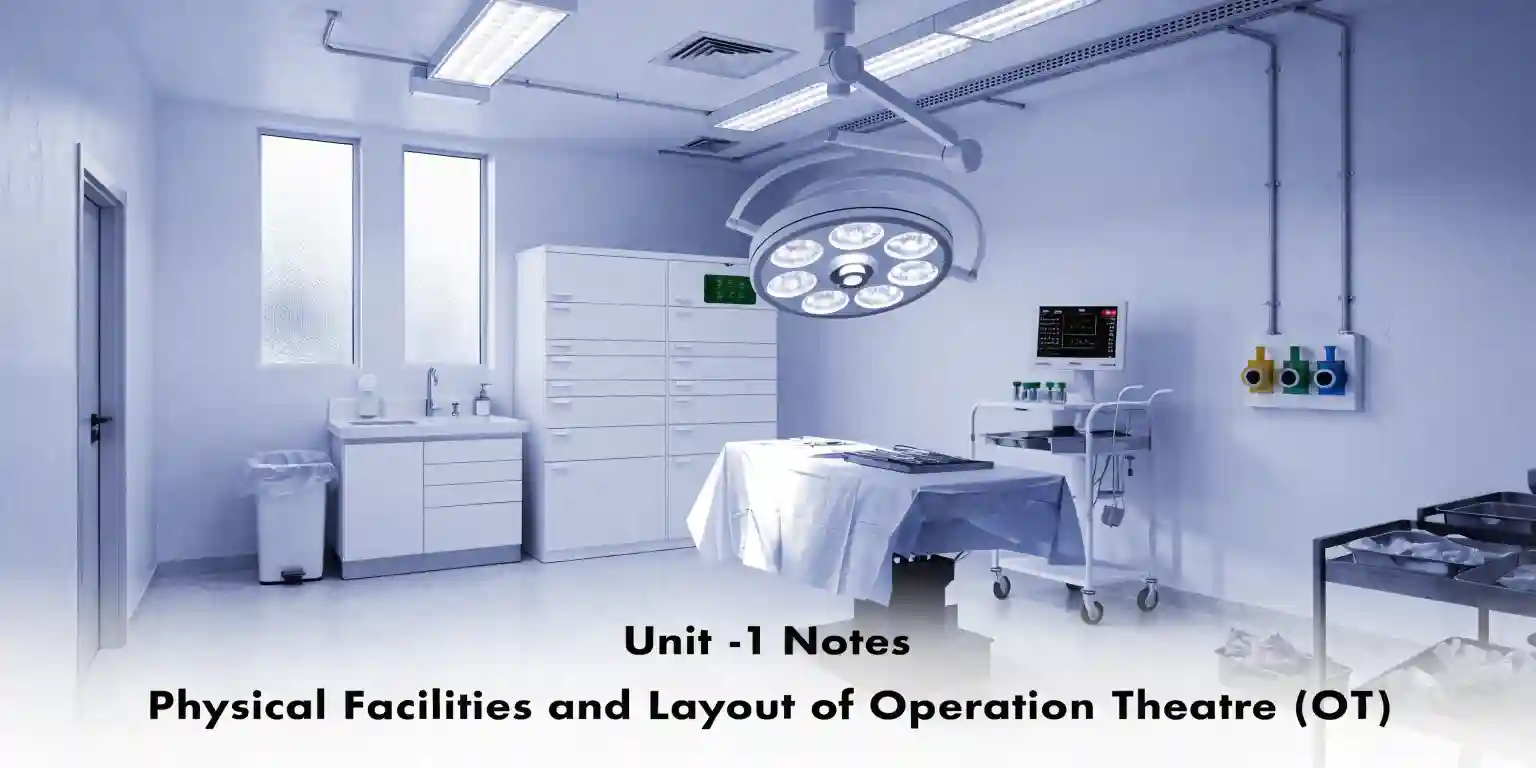
An Operation Theatre (OT) is a specially designed and equipped area where investigative, diagnostic, therapeutic, and palliative surgical procedures are performed. The design and planning of an OT depend on factors such as hospital size, patient turnover, and specialty requirements.
The primary objective of an OT is to provide maximum benefit to the greatest number of patients while ensuring safety, efficiency, and infection control. Both present and future requirements should be considered during planning.
Physical Facilities of an Operation Theatre
The major physical facilities include:
Public Areas
Clinical Areas
Consultation Rooms
Special Examination Rooms
Administrative Areas
Circulation Areas
Ancillary and Auxiliary Facilities
Layout of Operation Theatre
A properly designed OT should provide a calm, comfortable, and safe environment for patients, surgeons, and healthcare workers.
A. Doors
Sliding doors are preferred in operation theatres.
Door surfaces should be smooth and easy to clean.
Doors should remain closed to maintain sterility.
Doors should never be left open unnecessarily.
Doorways must be wide enough for patient trolleys and equipment movement.
B. Ventilation
Proper ventilation is essential to prevent suffocation and accumulation of anesthetic gases.
Requirements
Separate ventilation system from the main hospital.
Use ideal air-conditioning systems.
Control humidity levels.
Maintain efficient airflow.
Reduce the risk of explosions.
Maintain temperature between 70°F–75°F (21°C–24°C).
C. Walls
OT walls should be:
Jointless
Hard and non-porous
Waterproof
Stain-proof
Fire-resistant
Non-reflective
Easy to clean and disinfect
Mosaic walls are commonly used in operation theatres.
D. Ceiling
Moisture-proof ceilings should be used.
Fixed overhead operating lights are preferred.
E. Lighting
Proper lighting is essential for surgical precision.
Features
Uniform illumination throughout the OT.
White fluorescent lights are commonly used.
Operating lights should be shadowless.
Bright, cool lights are preferred.
Emergency lighting must always be available.
Maintain a lighting intensity ratio of 1:3 to 1:5 (room lighting to surgical site).
F. Furniture
OT furniture should be made of stainless steel because it is durable and easy to disinfect.
Examples
Operating table
Instrument tables
Ring stands
Sitting stools
G. Water Supply
Continuous water supply is essential.
Water should be clean and safe.
Water tanks should be cleaned regularly.
A separate water tank for the OT complex is preferred.
Transition of an Operation Theatre
Transition refers to preparing the operation theatre for a surgical procedure while maintaining a sterile environment.
Steps in OT Transition
1. Cleaning
Thorough cleaning of all surfaces.
Mopping floors.
Cleaning all equipment.
2. Sterilization
All instruments and equipment must be sterilized using:
Autoclaving
Chemical sterilization
Gas sterilization
3. Setting Up the Theatre
Arrange operating table.
Position surgical lights.
Prepare instruments and supplies.
4. Donning Sterile Attire
The surgical team wears:
Sterile gowns
Gloves
Masks
Caps
to maintain sterility.
Peripheral Support Areas
Several support areas are essential for smooth OT functioning.
1. Scrub Area
Used for surgical hand preparation and includes:
Scrub sinks
Sterile gowns
Gloves
Masks
2. Preoperative Holding Area
Patient assessment and preparation.
Administration of preoperative medications.
Final verification before surgery.
3. Anesthesia Work Area
Contains equipment for:
Administering anesthesia
Monitoring patient vital signs
4. Sterile Supply Storage
Stores sterile equipment and supplies.
5. Instrument Processing Area
Used for:
Cleaning instruments
Sterilization
Storage
6. Recovery Room
Patients are monitored immediately after surgery.
Functions
Monitor vital signs
Manage postoperative pain
Provide immediate postoperative care
7. Post-Anesthesia Care Unit (PACU)
Patients remain under observation until stable enough for discharge or transfer.
Central Control Desk
The central control desk monitors and coordinates OT activities.
Functions
Control traffic flow in surgical suites.
Schedule surgical procedures.
Coordinate communication.
Receive drugs, blood, and supplies.
Send specimens to laboratories.
Facilities
Computers
Printers
Fax machines
Internet access
Offices
Administrative offices should be accessible from unrestricted and semi-restricted areas.
Purpose
Administrative work
Staff coordination
Communication with external personnel
Locker Rooms and Lounges
Facilities
Separate dressing rooms for males and females.
Secure lockers.
Comfortable lounge areas.
Refrigerators and refreshment facilities.
Conference Room / Classroom
Used for:
In-service education
Staff meetings
Surgical teaching programs
Self-study
Facilities
Closed-circuit television
Video equipment
Reference library
Operating Room (Major and Minor)
The operating room is the main area where surgeries are performed.
Number of Operating Rooms Depends On
Hospital size
Number of surgeries performed
Inpatient capacity
Types
Major OT
Used for major surgical procedures.
Minor OT
Used for minor surgical procedures.
Surgical Suite Rooms
A surgical suite consists of specialized rooms designed for surgical care.
Components
Operating Room
Sterilization Area
Autoclaving Room
Recovery Room
Preparation Room
Scrub Room
Anesthesia Room
Store Room
OT In-Charge Office
Corridor
Surgeons’ Changing Room
Nurses’ Changing Room
Equipment Room
Linen Room
X-ray Room
Obstetric (Labour) Unit
Orthopedic Unit
Waiting Room
Casualty/Emergency Department
Surgical Day Care Unit
Endoscopy Unit
Intensive Care Unit (ICU)
Special Procedure Rooms
Special procedure rooms are designed for specific surgical procedures.
Examples
Cardiac Catheterization Laboratory
Used for:
Angiography
Stent placement
Cardiac interventions
Endoscopy Suite
Used for:
Colonoscopy
Gastroscopy
Upper GI Endoscopy
Endoscopy Unit
Endoscopy allows direct visualization of internal organs.
Procedures Performed
Bronchoscopy
Laryngoscopy
Colonoscopy
Gastroscopy
Cystoscopy
Surgical Day Care Unit
A unit where patients undergo procedures and return home on the same day.
Advantages
Reduced hospital crowding
Less preoperative workload
Shorter hospital stay
Cost-effective care
Potential Sources of Injury to Caregivers and Patients
The most common cause of caregiver injury is overexertion and fatigue.
Common Injuries
Abrasions
Lacerations
Hematomas
Fractures
Joint dislocations
Sprains
Strains
Burns
Workplace Hazards
Awkward postures
Repetitive movements
Lifting heavy loads
Slips, trips, and falls
Sharp instruments
Hazardous equipment
Injury Prevention for Caregivers
Keep head and neck aligned with the spine.
Maintain the natural spinal curve.
Bend using hips and knees.
Avoid twisting while lifting or carrying patients.
Use proper body mechanics.
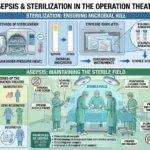
Principles of Asepsis
Asepsis refers to the prevention of contamination by microorganisms.
Principles
Use only sterile instruments and supplies.
Verify sterilization date and time.
Store sterile items appropriately.
Re-sterilize contaminated items.
Only the top surface of a draped table is considered sterile.
Maintain short, clean hair.
Use barrier techniques.
Re-sterilize contaminated sterile fields.
Wear masks during respiratory infections.
Perform proper hand hygiene before procedures.
Principles of Sterile Technique
Only sterile items are used within a sterile field.
Sterile personnel must be gowned and gloved.
Tables are sterile only at table level.
Sterile personnel touch only sterile items.
Unsterile personnel should not reach over sterile fields.
The edges of sterile packages are considered unsterile.
Unsterile persons must avoid sterile areas.
Sterile fields should be prepared immediately before use.
Sterile areas must remain continuously visible.
Sterile personnel should remain within sterile zones.
Contact with sterile areas should be minimized.
Microorganisms must be reduced to the lowest possible level.
Damage to sterile barriers results in contamination.
Conclusion
A well-designed operation theatre with proper infrastructure, support services, sterilization practices, and strict aseptic techniques ensures patient safety, reduces infection rates, and improves surgical outcomes. Understanding OT organization and sterile principles is essential for all operation theatre technology professionals.