

Introduction to Asepsis
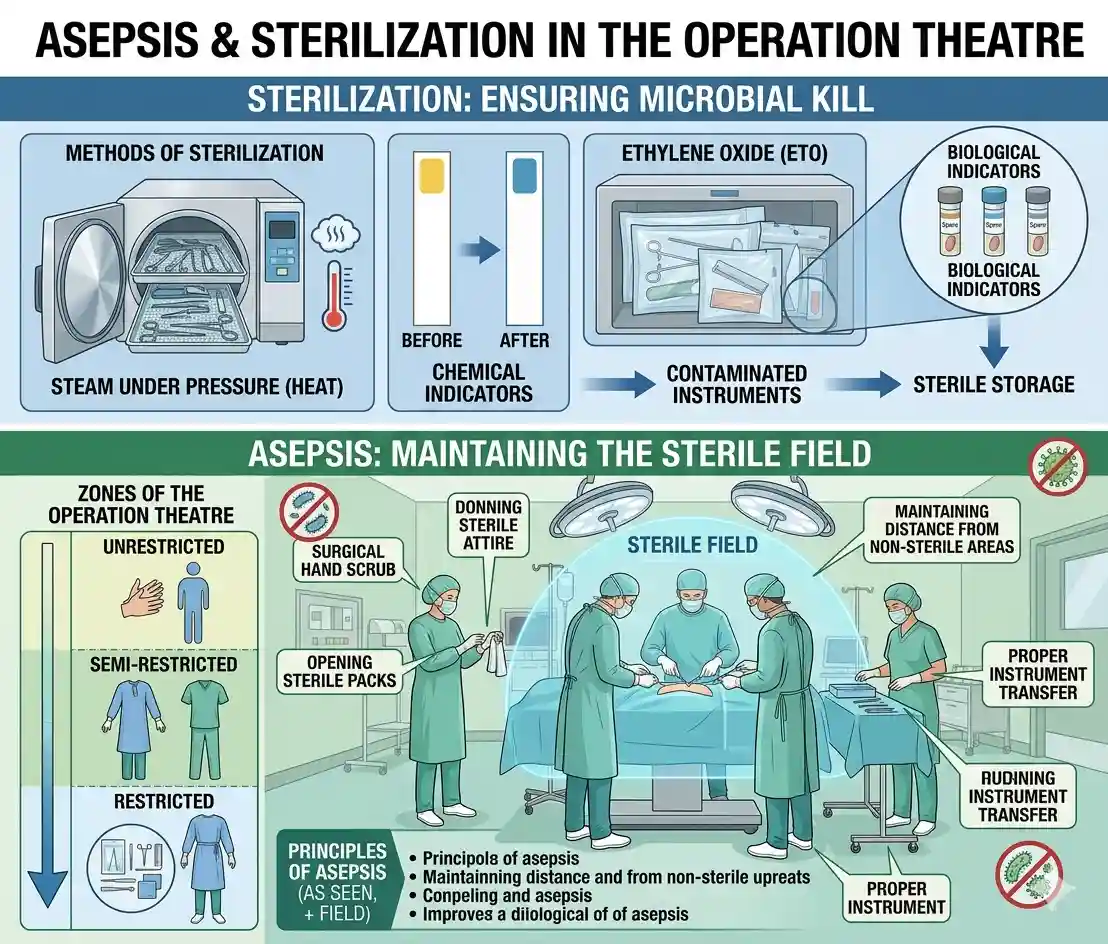
Asepsis is the condition in which objects, instruments, and articles are kept free from pathogenic microorganisms. It is maintained in various hospital departments such as operation theatres, labour rooms, and areas where invasive procedures are performed.
Healthcare professionals, including nurses and paramedical staff, must strictly follow surgical aseptic principles to prevent the transmission of infections from one person to another.
Principles of Surgical Asepsis
- Maintain a sterile environment during procedures.
- Follow standard hand hygiene practices.
- Use sterile gowns and gloves.
- Handle sterile equipment correctly.
- Prevent contamination of sterile fields.
- Dispose of contaminated materials appropriately.
Surgical Scrub
Definition
Surgical scrubbing is the process of removing microorganisms from the hands and arms through mechanical washing and chemical antiseptics before gowning and gloving.
Human skin contains two types of microorganisms:
Transient Microorganisms
- Acquired through direct contact.
- Easily removed by washing with soap and water.
Resident Microorganisms
- Present beneath the skin surface.
- Found in hair follicles, sebaceous glands, and sweat glands.
- Their growth is inhibited by antiseptic solutions such as povidone-iodine (Betadine).
Methods of Surgical Scrubbing
Two standard methods are used:
Timed Method
In this technique, each area of the hands and arms is scrubbed for a specific duration.
Procedure
- Wet hands and forearms.
- Apply 3–5 ml antiseptic solution.
- Wash hands and forearms up to 1–2 inches above the elbow.
- Rinse under running water with hands held upward.
- Scrub fingers, nails, and hands thoroughly.
- Reapply antiseptic solution.
- Continue scrubbing for approximately 3–5 minutes.
- Interlace fingers while scrubbing.
- Rinse thoroughly.
Counted Brush Stroke Method
In this method, a predetermined number of brush strokes are applied to each surface.
Procedure
- Wet hands and arms.
- Wash with antiseptic solution.
- Clean fingers and nails carefully.
- Rinse and keep hands elevated.
- Use a sterile brush or sponge.
- Apply antiseptic solution to the brush.
Recommended Stroke Count
- Fingernails: 30 strokes
- Each side of finger: 20 strokes
- Back of hand: 20 strokes
- Palm: 20 strokes
- Each third of arm up to elbow: 20 strokes
Repeat on the opposite hand and arm before rinsing thoroughly.
Surgical Gowning
Definition
A surgical gown acts as a protective barrier between the surgical team and the patient. Isolation gowns used in the operating theatre are generally intended for single use.
Preparation
- Remove watches and jewellery.
- Wash hands thoroughly.
- Avoid touching non-sterile objects.
- Wear a mask before gowning.
Procedure
- Dry hands and forearms using a sterile towel.
- Hold the gown by the inner surface only.
- Open the gown without touching the outside surface.
- Insert arms into armholes.
- Keep hands inside sleeves.
- Allow an assistant to secure the gown from behind.
- Tie gown tapes securely.
Surgical Gloving
Gloves are used in both medical and surgical procedures.
Purpose
- Prevent nosocomial infections.
- Protect patients with low immunity.
- Avoid direct contact with body fluids.
- Protect healthcare workers from infection.
Closed Gloving Technique
In the closed method, the hands remain inside the gown sleeves.
Procedure
- Place sterile glove pack on a sterile surface.
- Pick up the right glove using the left sleeve-covered hand.
- Position the glove over the right sleeve cuff.
- Insert fingers into the glove.
- Pull the glove over the gown cuff.
- Repeat on the opposite hand.
Open Gloving Technique
Procedure
- Open the sterile glove package.
- Place gloves on a sterile field.
- Apply powder if required.
- Pick up the first glove by the folded cuff.
- Insert the hand carefully.
- Use the gloved hand to wear the second glove.
Decontamination and Disinfection
Decontamination
Decontamination involves processes that remove or destroy contaminants so they cannot cause infection.
Physical Cleaning
Cleaning physically removes contamination and organic matter from surfaces and instruments.
Key Points
- Use detergent and warm water.
- Essential before disinfection or sterilization.
- Improves effectiveness of subsequent processes.
Ultrasonication
Ultrasonication is a cleaning method based on cavitation, where microscopic bubbles rapidly form and collapse in a liquid.
Advantages
- Cleans inaccessible areas.
- Effective for reusable instruments.
- Suitable for healthcare and laboratory settings.
Maintenance
- Clean ultrasonic units twice daily.
- Keep equipment dry overnight.
- Follow manufacturer recommendations.
Disinfection
Disinfection reduces microorganisms to levels unlikely to cause infection.
Types of Disinfection
Terminal Disinfection
Performed after:
- Patient discharge
- Transfer of patient
- Completion of treatment
Prophylactic (Recurrent) Disinfection
Examples include:
- Pasteurization of milk
- Chlorination of water
- Hand washing with soap and water
Sterilization Assembly and Packaging
The Central Sterile Supply Department (CSSD) ensures proper storage and distribution of sterile equipment.
Packaging Materials
- Sterile pouches
- Textiles
- Nonwoven wraps
- Rigid container systems
Functions of CSSD
- Assembly of instrument trays
- Packaging and sterilization
- Storage of sterile items
- Distribution to hospital departments
- Inventory management
Thermal Sterilization
Thermal sterilization uses heat to destroy microorganisms.
Types
Hot Air Oven
- Static air oven
- Forced air oven
Incineration
Used for disposal of contaminated medical waste.
Advantages
- Reliable sterilization method
- Suitable for heat-resistant materials
Chemical Sterilization
Chemical sterilization uses bactericidal chemicals to destroy microorganisms.
Applications
- Heat-sensitive plastics
- Fibre optic equipment
- Delicate medical devices
Gaseous Sterilization
Equipment is exposed to sterilizing gases in sealed chambers.
Advantages
- Excellent penetration
- Suitable for packaged items
- Does not damage many materials
Liquid Sterilization
Instruments are immersed in liquid sterilants.
Benefits
- Effective against microorganisms and spores
- Useful when gaseous methods are unsuitable
Radiation Sterilization
Radiation sterilization destroys microbial DNA.
Types of Radiation
Non-Ionising Radiation (Hot Sterilization)
Infrared Radiation
Used for:
- Syringes
- Catheters
- Pre-packed items
Ultraviolet Radiation
Used for:
- Operation theatres
- Laboratories
- Entryways
- Air disinfection
Ionising Radiation (Cold Sterilization)
Gamma Rays
Used for sterilizing:
- Plastic products
- Medical disposables
- Surgical supplies
X-Rays
Used for:
- Swabs
- Catheters
- Pharmaceutical products
- Packaging materials
Surgical Instrumentation
Definition
Surgical instruments are specialized tools used during surgical procedures to cut, grasp, hold, retract, or manipulate tissues.
Classification of Surgical Instruments
Graspers and Forceps
Used to grasp tissues and objects.
Examples
- Tissue Forceps
- Adson Forceps
- Bonney Forceps
- DeBakey Forceps
- Russian Forceps
Clamps
Used to hold tissues or blood vessels securely.
Surgical Scissors
Used for cutting and dissecting tissues.
Examples
- Mayo Scissors
- Metzenbaum Scissors
- Pott’s Scissors
- Iris Scissors
Bipolar Electrosurgical Forceps
Features:
- No cautery plate required
- Heat-producing electrodes at forceps tips
- Precise coagulation
Fabrication in the Operating Theatre
Fabrication refers to the creation of custom medical devices during surgical procedures.
Purpose
- Develop patient-specific implants
- Produce customized prosthetics
- Support complex surgical procedures
Advantages
- Improved fit and function
- Better surgical outcomes
- Enhanced patient safety
Requirements
- Highly skilled biomedical engineers
- Sterile manufacturing conditions
- Strict quality control standards
- Compliance with safety regulations
Conclusion
Asepsis, surgical scrubbing, gowning, gloving, decontamination, sterilization, and proper surgical instrumentation are essential components of operation theatre practice. Strict adherence to these procedures helps prevent infections, maintain patient safety, and ensure successful surgical outcomes.
