Powered Surgical Instruments
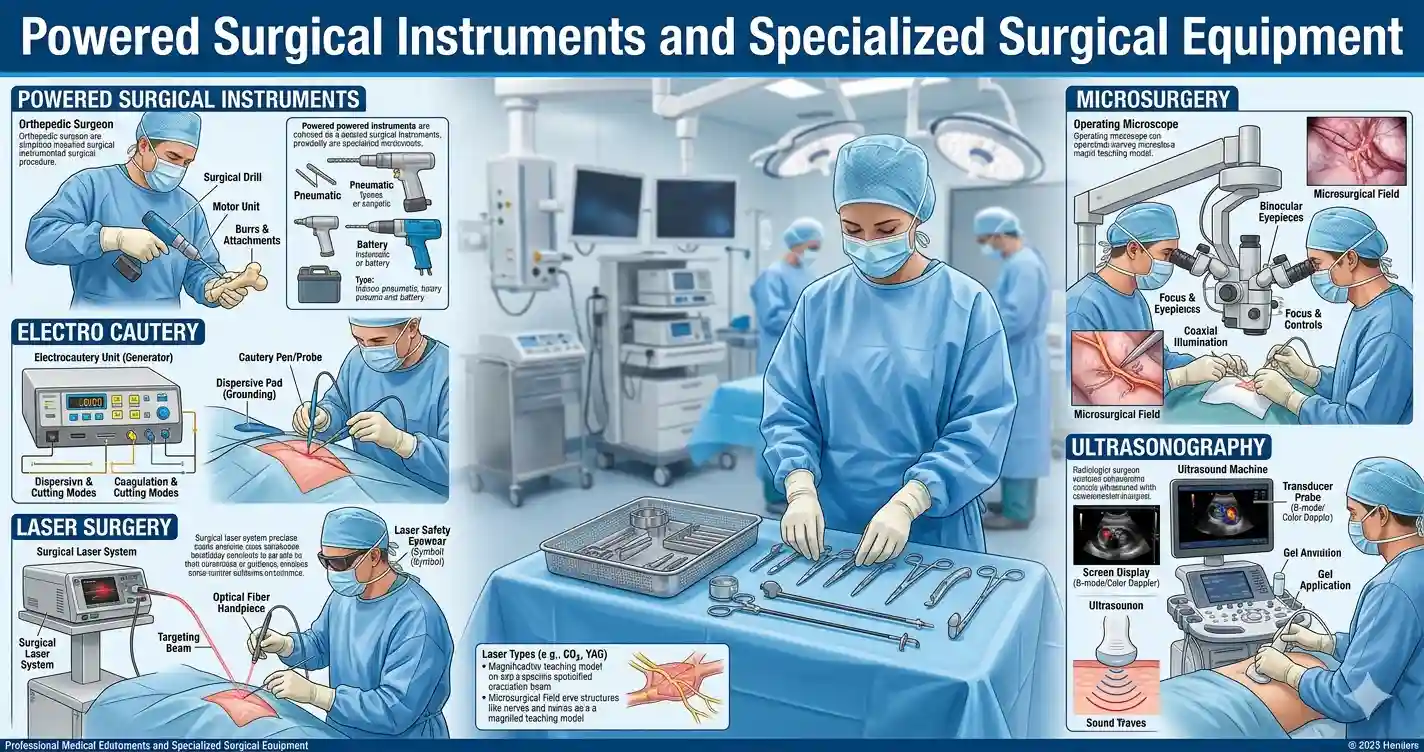
Powered Surgical Instruments (PSIs) are technological devices used to assist in the performance of orthopedic and neurological surgeries.
Product Categories of Powered Surgical Instruments
Pneumatic large bone equipment
Battery/electric large bone equipment
Pneumatic small bone equipment
Electric small bone equipment
High-speed equipment
Surgeons often employ:
Surgical drills
Surgical saws
Clip appliers
Surgical staplers
RF electrosurgery systems are routinely used to cut and cauterize tissue in nearly all types of surgical procedures.
Types of Powered Surgical Instruments
There are three main types of PSIs:
Electrically powered
Pneumatically powered
Battery powered
Handling Instruments During Surgical Procedures
Efficient instrument handling throughout the surgical procedure is the hallmark of an efficient scrub person.
Key Points in Instrument Handling
Know the name and appropriate use of each instrument.
Handle instruments individually. Tangled instruments are difficult to separate during emergencies.
Hand the surgeon or assistant the correct instrument for each particular task.
Avoid placing fingers in the instrument rings while passing instruments.
Hand instruments around the incisional area, not directly over it, to prevent possible injury.
Pass instruments decisively and firmly. When the surgeon extends his/her hand, the instrument should be placed firmly into the palm in the proper position for use.
Wipe blood and organic debris from instruments promptly after each use with a moist sponge.
Flush suction tips and tubing with sterile distilled water periodically to keep lumens patent.
Remove debris from ESU tips to ensure electrical contact.
Place used instruments that will not be needed again into a tray or basin during or at the end of the procedure.
Keep instruments accessible for final counts.
Electro Cautery
The use of electricity in surgery is referred to as electrosurgery. Electricity is used in surgeries for many purposes, but electrosurgery mainly indicates the use of electricity for cutting tissues and coagulating blood vessels.
For cutting and coagulation, a high-frequency electric current is generated by a diathermy machine and passed to the patient through cautery.
Types of Cautery
1. Monopolar Cautery
In a monopolar cautery system:
Current is applied to the patient by an active electrode (cautery forceps held by the surgeon).
The current passes through the entire body of the patient.
It returns to the diathermy machine through a passive electrode in the form of an aluminum plate attached to the patient’s muscle.
2. Bipolar Cautery System
In a bipolar cautery system:
No cautery plate is required.
Heat-producing electrodes are present on the tips of the forceps.
Indications
High Temperature
Surgical hemostasis of blood vessels.
Low Temperature
Tissue destruction in:
Small angiomas
Acrochordons
Syringomas
Specialized Surgical Equipment
Specialized surgical equipment refers to medical instruments and tools designed for specific surgical procedures or medical specialties.
Examples
1. Laparoscopic Instruments
Used in minimally invasive surgeries such as:
Gallbladder removal
Hernia repair
Appendectomy
2. Endoscopes
Used to visualize and access internal organs such as:
Gastrointestinal tract
Bladder
Bronchi
3. Neurosurgical Instruments
Used for:
Brain surgery
Spinal fusion
Nerve procedures
4. Cardiovascular Instruments
Used in:
Bypass surgery
Angioplasty
5. Orthopedic Instruments
Used in:
Joint replacements
Spinal surgery
LASER
Laser technology is widely used in hospitals for various medical procedures. The intense, focused beams of light produced by lasers can be used for cutting, ablation, coagulation, and sterilization of tissues.
Applications of Lasers
1. Surgery
Used in:
Eye surgery
Dermatological surgery
Cancer surgery
2. Dermatology
Used for:
Hair removal
Skin resurfacing
Tattoo removal
Acne treatment
Rosacea treatment
Psoriasis treatment
3. Oncology
Used in:
Photodynamic therapy
Cancer treatment
4. Dentistry
Used for:
Teeth whitening
Gum surgery
Cavity removal
5. Endoscopy
Used to remove or destroy:
Polyps
Tumors
Abnormal tissues
Procedures Using Lasers
Cosmetic surgery
Refractive eye surgery (LASIK, PRK)
Dental procedures
Tumor removal
Cataract removal
Breast surgery
Plastic surgery
Risks and Benefits
Benefits
More complex procedures can be performed.
Reduced blood loss.
Reduced postoperative discomfort.
Reduced wound infection risk.
Better wound healing.
Risks
Incomplete treatment.
Pain.
Infection.
Bleeding.
Scarring.
Skin color changes.
Laser surgery uses non-ionizing radiation and therefore does not have the same long-term risks as X-rays or other ionizing radiation.
Microsurgery
Microsurgery is a general term for surgery requiring an operating microscope.
The most significant developments include procedures that allow anastomosis of very small blood vessels and nerves (typically 1 mm in diameter), enabling:
Tissue transfer from one body part to another.
Reattachment of severed body parts.
Specialties Using Microsurgery
General Surgery
Ophthalmology
Orthopedic Surgery
Gynecological Surgery
Otolaryngology
Neurosurgery
Oral and Maxillofacial Surgery
Plastic Surgery
Podiatric Surgery
Pediatric Surgery
How Microsurgery is Performed
Microsurgery uses:
Fine-tipped instruments
High-magnification microscopes (40–50× magnification)
Specialized surgical tools
These allow surgeons to disconnect and reconnect tissues with extreme precision.
Ultrasonography
Definition
An ultrasound is similar to an X-ray, but it uses sound waves instead of radiation to create black-and-white images from inside the body.
Operation Theatre Technology Notes |Asepsis and Sterilization in Operation Theatre
Operation Theatre Technology Notes | OT Layout
A handheld device called a transducer sends high-frequency sound waves through the body.
The sound waves echo off body structures, and a computer converts these echoes into visual images.
Ultrasound allows healthcare providers to visualize organs and monitor fetal growth during pregnancy.
Advantages
Superior soft-tissue imaging compared to conventional radiographs.
Best modality for near-field imaging.
Provides information about:
Size
Localization
Echogenicity
Margins
Invasion into surrounding structures
Offers clear definition of:
Cutaneous layers
Muscular layers
Mucosal layers
Disadvantages
Deep structures are visualized less accurately.
Operator dependent.
Sound waves cannot penetrate thick bone.
Sound waves are scattered by gas.
Principles of Ultrasound
Ultrasound uses sound waves beyond the audible frequency (>20,000 Hz) for diagnostic purposes.
Therapeutic Uses
1. Heat Generation
Used for:
Low back pain
Muscle strains
Tissue regeneration
Killing malignant cells
2. Stone Fragmentation
Used to pulverize:
Kidney stones
Gallstones