Emergency Intubation : Indications, Procedure, Challenges, and Best Practices in Critical Care
Introduction
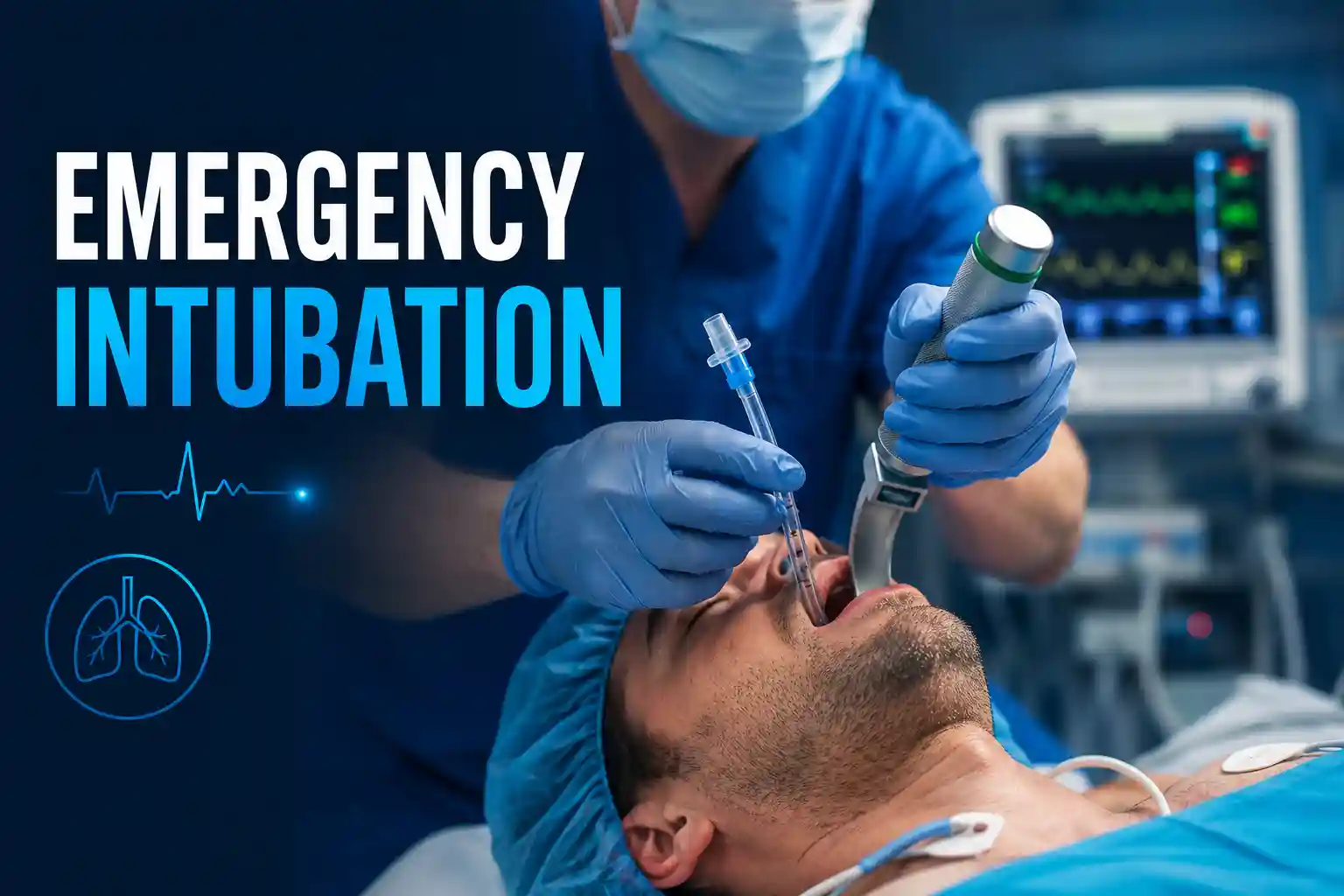
Emergency intubation is a life-saving procedure performed to secure and maintain a patient’s airway when spontaneous breathing is inadequate or airway protection is compromised. Endotracheal intubation remains one of the most critical interventions in emergency medicine, anesthesia, trauma care, and intensive care units (ICUs). The procedure involves inserting an endotracheal tube (ETT) through the mouth or nose into the trachea to facilitate oxygenation, ventilation, and airway protection.
Emergency airway management differs significantly from elective intubation because patients are often physiologically unstable, hypoxic, hypotensive, or suffering from life-threatening conditions. Consequently, healthcare professionals must possess the knowledge, skills, and clinical judgment necessary to perform emergency intubation safely and efficiently.
This article reviews the indications, preparation, techniques, complications, and best practices associated with emergency intubation in modern clinical practice.
Understanding Emergency Intubation
Emergency intubation refers to the urgent placement of an endotracheal tube in patients who cannot maintain a patent airway, adequately oxygenate, ventilate, or protect their airway from aspiration.
The primary objectives of emergency intubation include:
– Securing airway patency
– Ensuring adequate oxygenation
– Facilitating mechanical ventilation
– Preventing aspiration
– Supporting critically ill patients during resuscitation
Successful airway management requires rapid assessment, proper preparation, and effective teamwork.
—
Indications for Emergency Intubation
A useful framework for determining the need for emergency intubation is the “failure to oxygenate, ventilate, or protect the airway.”
1. Airway Protection
Patients may require intubation when they cannot protect their airway due to:
– Reduced level of consciousness
– Severe traumatic brain injury
– Drug overdose
– Stroke
– Seizure activity
– Post-cardiac arrest state
A Glasgow Coma Scale (GCS) score of 8 or less is commonly considered an indication for airway protection.
2. Respiratory Failure
Hypoxemic Respiratory Failure
Occurs when oxygen levels remain critically low despite supplemental oxygen.
Examples include:
– Acute Respiratory Distress Syndrome (ARDS)
– Severe pneumonia
– Pulmonary edema
– COVID-19-related respiratory failure
Hypercapnic Respiratory Failure
Results from inadequate ventilation and elevated carbon dioxide levels.
Common causes:
– COPD exacerbation
– Neuromuscular disorders
– Severe asthma
– Drug-induced respiratory depression
3. Airway Obstruction
Emergency intubation may be necessary in:
– Anaphylaxis
– Airway burns
– Facial trauma
– Neck hematoma
– Foreign body aspiration
– Angioedema
4. Cardiac Arrest
Advanced Cardiac Life Support (ACLS) protocols may require definitive airway placement during prolonged resuscitation.
5. Major Trauma
Trauma patients may require immediate airway control due to:
– Maxillofacial injuries
– Cervical spine injuries
– Hemorrhagic shock
– Altered mental status
—
Airway Assessment Before Intubation
A rapid but systematic airway evaluation is essential.
LEMON Assessment
The LEMON approach helps identify difficult airways.
L – Look Externally
Assess for:
– Facial trauma
– Large tongue
– Beard
– Obesity
– Short neck
E – Evaluate 3-3-2 Rule
– Mouth opening ≥ 3 finger breadths
– Mandibular space ≥ 3 finger breadths
– Thyromental distance ≥ 2 finger breadths
M – Mallampati Score
Evaluates visibility of oral structures.
O – Obstruction
Look for signs of:
– Tumors
– Swelling
– Foreign bodies
N – Neck Mobility
Limited mobility increases intubation difficulty.
—
Preparation for Emergency Intubation
Proper preparation significantly improves first-pass success rates.
Equipment Checklist
Essential equipment includes:
– Laryngoscope
– Video laryngoscope
– Endotracheal tubes
– Stylet
– Bougie
– Syringe
– Suction apparatus
– Bag-valve-mask (BVM)
– Oxygen source
– Capnography device
Monitoring
Continuous monitoring should include:
– Pulse oximetry
– ECG
– Blood pressure
– End-tidal CO₂ monitoring
Team Preparation
Clearly assign roles for:
– Airway operator
– Medication administration
– Monitoring
– Documentation
– Backup airway managementOT Protocols Guide: Complete Standard Operating Procedures for Safe and Efficient Operation Theatre Management
—
Rapid Sequence Intubation (RSI)
Rapid Sequence Intubation is considered the gold standard for emergency airway management.
RSI involves the rapid administration of a sedative followed immediately by a neuromuscular blocking agent to facilitate endotracheal tube placement while minimizing aspiration risk.
Seven Ps of RSI
1. Preparation
Gather equipment, medications, and personnel.
2. Preoxygenation
Administer 100% oxygen for 3–5 minutes.
Methods include:
– Non-rebreather mask
– Bag-valve-mask
– High-flow nasal oxygen
3. Pretreatment
Selective use of medications in specific clinical situations.
4. Paralysis with Induction
Administer induction and paralytic agents.
Common Induction Agents
Etomidate
Advantages:
– Hemodynamic stability
– Rapid onset
Ketamine
Advantages:
– Maintains blood pressure
– Bronchodilation
– Useful in asthma
Propofol
Advantages:
– Rapid onset
– Short duration
Disadvantage:
– Hypotension
Neuromuscular Blocking Agents
Succinylcholine
Advantages:
– Rapid onset
– Short duration
Contraindications:
– Hyperkalemia
– Neuromuscular disease
– Major burns
Rocuronium
Advantages:
– Alternative to succinylcholine
– Fewer contraindications
5. Protection and Positioning
Optimize patient positioning.
The sniffing position is commonly used unless cervical spine injury is suspected.
6. Placement
Insert the endotracheal tube under direct or video laryngoscopic guidance.
7. Post-Intubation Management
Confirm placement and initiate mechanical ventilation.
—
Confirmation of Endotracheal Tube Placement
Correct tube placement must be confirmed immediately.
Primary Confirmation Methods
Waveform Capnography
Considered the gold standard.
Persistent end-tidal CO₂ confirms tracheal placement.
Bilateral Chest Rise
Observe symmetrical chest expansion.
Auscultation
Listen over:
– Both lung fields
– Epigastrium
Absence of gastric sounds supports correct placement.
Chest X-Ray
Confirms tube depth and positioning.
Ideal tube tip position:
– 3–5 cm above the carina
—
Difficult Airway Management
Not all emergency airways are straightforward.
Predictors of Difficult Intubation
– Obesity
– Facial trauma
– Airway edema
– Limited mouth opening
– Cervical spine immobilization
Rescue Airway Devices
Supraglottic Airway Devices
Examples:
– Laryngeal Mask Airway (LMA)
– i-gel
These devices provide temporary airway control when intubation fails.
Bougie-Assisted Intubation
A bougie improves success rates in difficult laryngoscopy.
Video Laryngoscopy
Increasingly preferred due to improved glottic visualization.
—
Complications of Emergency Intubation
Emergency intubation carries significant risks.
Immediate Complications
Hypoxia
Can occur during prolonged attempts.
Hypotension
Common after induction medications.
Esophageal Intubation
A potentially fatal complication if not recognized promptly.
Aspiration
Risk increases in unfasted patients.
Dental Trauma
Frequently encountered during difficult laryngoscopy.
Delayed Complications
Ventilator-Associated Pneumonia
Associated with prolonged mechanical ventilation.
Tracheal Injury
May result from traumatic insertion.
Laryngeal Edema
Can complicate extubation.
Vocal Cord Injury
Rare but clinically significant.
—
Post-Intubation Care
Successful airway management extends beyond tube placement.
Mechanical Ventilation
Ventilator settings should be tailored according to:
– Patient size
– Disease process
– Blood gas analysis
Sedation and Analgesia
Adequate sedation improves patient comfort and ventilator synchrony.
Common medications include:
– Propofol
– Midazolam
– Dexmedetomidine
– Fentanyl
Hemodynamic Monitoring
Monitor for:
– Hypotension
– Arrhythmias
– Shock
Reassessment
Continuous reassessment ensures:
– Proper tube position
– Adequate oxygenation
– Effective ventilation
—
Special Considerations
Pediatric Emergency Intubation
Children have:
– Smaller airways
– Higher oxygen consumption
– Rapid desaturation
Appropriate equipment sizing is critical.
Trauma Patients
Airway management must prioritize:
– Cervical spine protection
– Hemorrhage control
– Oxygenation
COVID-19 and Infectious Diseases
Airway interventions increase aerosol generation.
Recommendations include:
– Full personal protective equipment (PPE)
– Video laryngoscopy
– Experienced airway operators
—
Best Practices for Emergency Intubation
To improve patient outcomes:
1. Perform systematic airway assessment.
2. Prepare backup airway plans.
3. Use rapid sequence intubation when appropriate.
4. Prioritize first-pass success.
5. Utilize waveform capnography.
6. Monitor continuously after intubation.
7. Ensure effective team communication.
8. Conduct regular airway management training.
—
Conclusion
Emergency intubation is a cornerstone of critical care and emergency medicine. It is a high-stakes procedure that demands rapid decision-making, technical expertise, and meticulous preparation. Successful emergency airway management requires early recognition of airway compromise, comprehensive patient assessment, appropriate use of rapid sequence intubation, and continuous post-intubation monitoring.
As airway management technologies continue to evolve, including video laryngoscopy and advanced airway devices, healthcare professionals must remain proficient in both fundamental and advanced airway techniques. Adherence to evidence-based practices and ongoing training can significantly improve first-pass success rates, reduce complications, and ultimately enhance patient survival and outcomes in emergency settings